.png?width=380&height=58&name=Layer_1%20(3).png "Compoze Labs Logo")


Legacy Systems Can't Keep Pace
Your ERP and CRM were built for a different scale of data and a slower cadence of decisions. Every new opportunity now turns into a technical project before it becomes a business one.
Your 20-year-old ERP still works, sort of. New opportunities turn into workarounds and integrations turn into projects, while your competitors keep moving. We help companies modernize the systems they can't replace cleanly: keeping what works, extending where it counts, and engineering the layer underneath so AI, analytics, and the next ten years of growth have somewhere to stand.
Most leaders have known their legacy stack was slowing them down for years. What kept modernization on the back burner wasn't the business case. It was the cost, the timeline, and the risk of touching systems the whole company runs on. AI changed all three this year, and the modernization roadmap you've been writing in your head finally pencils out.
Your ERP and CRM were built for a different scale of data and a slower cadence of decisions. Every new opportunity now turns into a technical project before it becomes a business one.
Real-time visibility, instant quotes, configurable experiences: none of it is optional anymore. Manual workarounds and overnight batch jobs are starting to show up as churn.
Most packaged software gets you 70% of what you need or 130% of what you'll pay for, and the over-customization needed to cover the difference locks you in. Doing nothing locks you in worse.
Why your legacy platform is more expensive than you thinkSide bonus: the same modernization that fixes integration, customer experience, and software bloat also gives you the governed data layer AI needs. 60% of AI leaders say legacy integration is the primary barrier to running agentic workflows in production. Modernize for the first three reasons, and AI readiness comes with it.
Why your AI initiatives stalledWe don't sell software, and we don't sell platforms. We bring full-stack teams that engineer the capabilities your business needs to compete, incrementally and in production, owning the solution end to end alongside yours.
Build exactly what you need. No bloat, no gaps, no $200K platforms with $400K of customization layered on top.
Transform in phases that deliver value in quarters, not years. No big-bang risk, no operational disruption.
Build for change. Every component should be replaceable without a rewrite, including the work we deliver.
We build with you and own the solution end to end. Engineering, architecture, and product strategy in one room with your team, working in agile cycles with every milestone tied to outcomes you can defend to leadership.
We assess your current state across systems, data, and capabilities. We talk to operators, engineers, and decision-makers. You leave the discovery phase with a clear-eyed view of what's working, what's blocking growth, and where the highest-leverage modernization investments are.
We design what the next version of your stack should look like. That includes where an abstraction layer makes more sense than a replacement, where event-driven integration unblocks the rest of the roadmap, and what gets sunset and when. Tradeoffs written down where you can defend them.
We implement incrementally, in cycles your team can use as we go. AI-augmented engineering helps us compress timelines without compressing quality. The new capability replaces the old workaround, cycle by cycle.
The team that built the solution with you supports it with you. Runbooks, tests, architecture decisions, the operational groundwork that keeps things working. Most clients use the end of one phase as the start of the next, because the modernization roadmap is rarely one project. It's a partnership that keeps unlocking the next capability.
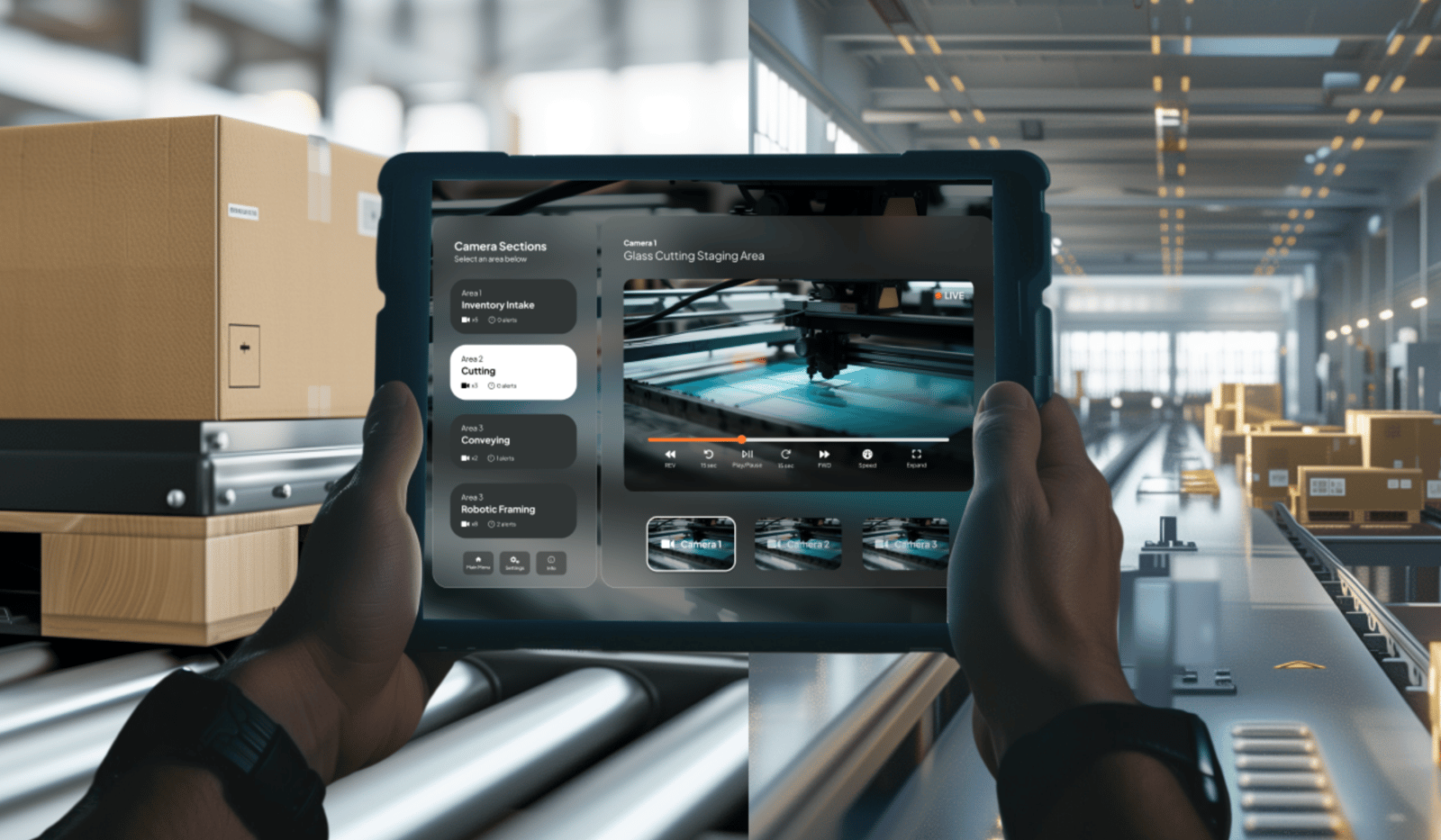
A growth-stage manufacturer was losing time and customer trust to outdated operational manuals, inconsistent machine use, and operator training that took weeks. Replacing the machines would have meant a multi-year capital project and a paused production line. We modernized the layer that sits between the operator and the machine instead, while the equipment stayed in place.
We built a tablet-based application that connects directly to the existing equipment, with live camera feeds, real-time error monitoring, machine-specific training modules, and a clean operator interface that made the job faster and safer to learn. The machines stayed put while the operator experience around them shifted entirely.
Modernization is its own discipline, with its own approach and its own engagements. It also runs alongside the rest of how Compoze works. The data layer underneath, the new applications on top, and the AI capabilities you're building toward each have their own practice. The ones below are the most common companions to a modernization roadmap.
The data layer the rest of your stack depends on. We modernize that data at the core, connect it across your ecosystem, and engineer it to feed analytics, applications, and AI.
Explore Data EngineeringWhen modernization means building the new capability layer on top of the legacy stack.
Explore Application DevelopmentWhen the goal of modernization is AI readiness: agents, automation, custom models, and RAG.
Explore AI ServicesThe capability-first approach changes the math on modernization. Faster delivery, lower integration cost, and the kind of partnership that earns the next phase of work.
If you're sitting with the same question your competitor's IT lead is asking, you're probably in the right place.
Usually no, and that's often the wrong place to start. Most of the value comes from modernizing the layer that surrounds the legacy system. The system of record can stay put while modern customer experiences, AI workflows, and integrations ship in months on top of it. If and when a full replacement makes sense later, the work you do first protects everything you've built.
Discovery is two to four weeks. First production capability typically ships in 6–12 weeks. Full modernization roadmaps run one to three quarters at a time, with each phase delivering working software your team uses immediately. We don't do year-long waterfalls ending in a launch event.
It means we use AI to do this work faster: assessment in days instead of weeks, code analysis on legacy systems that would take a human team months, parallel-run validation that finds edge cases earlier. It also means we're building toward systems that can themselves host AI agents and modern automation, with the workflow itself reimagined rather than just sped up.
We bring a full-stack team that owns the solution with you end to end: engineering, architecture, product strategy, and the long-term support that keeps things running. If you want to grow internal ownership alongside the work, we plan for that explicitly. If you'd rather have us keep building and operating, that's how most engagements continue. Either way, the system isn't held together by knowledge that lives only in our heads.
Traditional systems integrators are usually paid to implement vendor software at scale. We're paid to engineer capabilities, which sometimes means commercial platforms in the places they fit and sometimes means custom builds in the places you compete. We don't have a software allegiance to defend, which means our recommendation is honest about where to extend, where to replace, and where to leave alone.
Modernization usually touches both. The data layer underneath nearly every modernization roadmap is its own engineering effort (see Compoze Data Engineering). When the goal of modernization is AI readiness, our AI services pick up where modernization ends. You don't need to know which one you need first. The discovery phase makes that call.
Whether it's a 20-year-old ERP, a CRM that can't keep up with your e-commerce ambitions, or an integration layer that's been breaking for three years, that's the conversation we want to have.
.png)
© 2026 Compoze Labs